Solvent Ink Adhesion Problems: How to Improve Printing on Different Media
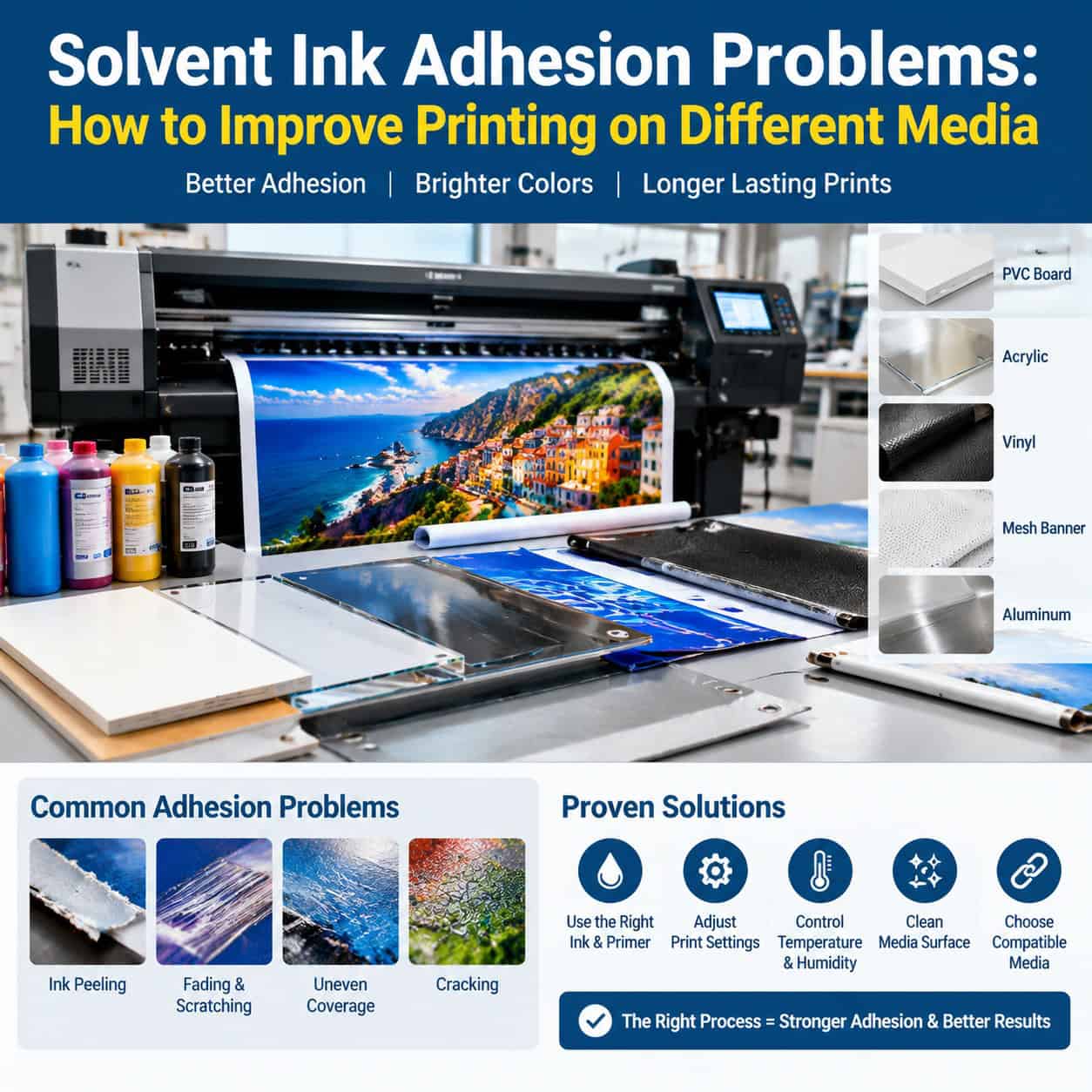 If your solvent ink rubs off like cheap paint on a rainy fence, the ink isn’t the only suspect. Adhesion is a system problem. Substrate, surface prep, ink chemistry, drying, and the environment all vote. When one votes no, the print fails. That’s true whether you’re printing on flexible vinyl, rigid PET, low-surface-energy polypropylene, coated paper, metal, or glass.
ADHESION IS A RELATIONSHIP, NOT A PROPERTY
A solvent ink doesn’t “stick” in the abstract. It wets a surface, flows into microscopic valleys, and forms bonds. Those bonds can be mechanical, chemical, or both. For wetting to happen, the substrate’s surface energy needs to be higher than the ink’s surface tension. Low surface energy plastics like PE and PP are notorious because they sit below many solvent inks. Dyne pens and contact angle measurements give you a number, not a guess. If the number is low, no amount of press tweaking will fix it.
Treatment is the first lever. Corona, plasma, and flame treatment raise surface energy and add polar groups. The catch is timing. Treatment fades. Print immediately after treating, or store treated stock in a controlled way. Over-treatment can create a weak boundary layer of low-molecular-weight debris, so more is not always better. Test treated substrate with a dyne pen and a tape pull before you run a full roll.
THE SUBSTRATE DOESN’T CARE ABOUT YOUR SCHEDULE
Different media fail for different reasons. Vinyl often contains plasticizers that migrate to the surface and soften the ink film. A standard solvent ink may look fine for a day, then peel or become tacky. You need a plasticizer-resistant resin system or a primer designed for vinyl. PET has decent surface energy, but its surface can be too smooth for mechanical grip. Corona treatment or a primer helps. PP and PE need treatment plus a primer, often chlorinated polyolefin based, to bridge the gap. Coated papers can absorb solvent too quickly or too slowly. If the coating is too tight, the ink sits on top and rubs off. If it’s too open, the ink strikes in and loses gloss or color strength. Metal and glass bring their own issues: oils, oxidation, and smooth surfaces that demand cleaning and sometimes a silane or titanate adhesion promoter.
CHEMISTRY THAT ACTUALLY STICKS
Ink formulation is not a black box, even if some suppliers treat it like one. The resin system does the heavy lifting. Polyurethane resins often balance flexibility and adhesion on plastics. Acrylics can offer outdoor durability. Chlorinated polyolefins are common for untreated or lightly treated PP and PE. Solvent blends matter too. A solvent that evaporates too fast can dry before the ink wets the surface. A solvent that evaporates too slow can trap solvent, cause blocking, or attack the substrate. Adhesion promoters can help, but they must match the substrate. Silanes for glass and metal, titanates and zirconates for certain plastics. Watch out for additives that fight adhesion. Silicone slip agents, waxes, and some surfactants migrate to the surface and create a release layer. If you switch additives, retest adhesion.
DRYING IS NOT JUST BLOWING AIR
Solvent ink adhesion often fails in the dryer, not on the substrate. Too much heat too fast skins the ink, traps solvent, and prevents proper bonding. Too little heat leaves the film soft, prone to offset, and weak. You need a drying profile, not a single temperature. Preheat gently, then ramp. Airflow matters as much as heat. For heat-sensitive media, use lower temperatures and higher air velocity. For non-porous substrates, solvent has nowhere to go but up, so dwell time and exhaust are critical. Retained solvent can also attack the substrate or cause delamination later. If you use two-part inks, respect mix ratio, induction time, and pot life. Under-cured ink will fail rub and chemical tests. Over-cured ink can become brittle and crack.
THE ENVIRONMENT IS A SILENT PARTNER
Humidity, temperature, and static all influence adhesion. High humidity can condense moisture on a cold substrate, creating a barrier between ink and surface. Static attracts dust and causes pinholes. Cold substrates lower surface energy and slow solvent release. Warm substrates can flash off solvent too quickly. Keep the pressroom stable. Clean rollers, belts, and guides. Oils from hands and machinery are adhesion killers. You don’t need a cleanroom for every job, but you do need discipline.
TEST LIKE YOU MEAN IT
A tape pull after five minutes proves almost nothing. Adhesion can build over 24 hours or more. Use the right tests for the job: ASTM D3359 cross-hatch tape, coin scratch, rub test, solvent rub, flex and crease, heat seal, and weather exposure. Test the actual production substrate, ink, speed, and cure. Lab samples that sat for a week are not production samples. Keep a log. When a job fails, you want data, not opinions.
A PRACTICAL TRIAGE PLAN
When adhesion fails, identify the failure mode first. If the ink peels cleanly off the substrate, the problem is usually surface energy, contamination, or missing primer. If the ink splits within itself, it’s likely cohesion, cure, or resin choice. If it rubs off, suspect surface prep or under-cure. Check surface energy with a dyne pen. Clean the substrate. Treat it. Apply the right primer. Adjust ink viscosity and solvent blend. Fix the drying profile. Retest after 24 hours. Change one variable at a time, or you’ll learn nothing.
THE MARKETING PART, WITHOUT THE FLUFF
You can buy ink by the drum and still lose money on adhesion failures. Scrap, rework, customer returns, and press downtime cost more than the ink. The smarter buy is a solvent ink system with substrate-specific primers, clear technical data, and a partner who will audit your corona treatment, primer application, and drying zones. Ask for adhesion test kits. Ask for on-press support. Ask what happens when you switch from vinyl to PET to PP in the same shift. If the answer is a shrug, keep shopping.
Adhesion is not magic. It’s measurement, chemistry, and discipline. Get the surface right, match the ink to the media, control the dry, and test like your reputation depends on it. Because it does