Chemical Protective Coverall with Sealed Seams: When Is It the Right Choice?
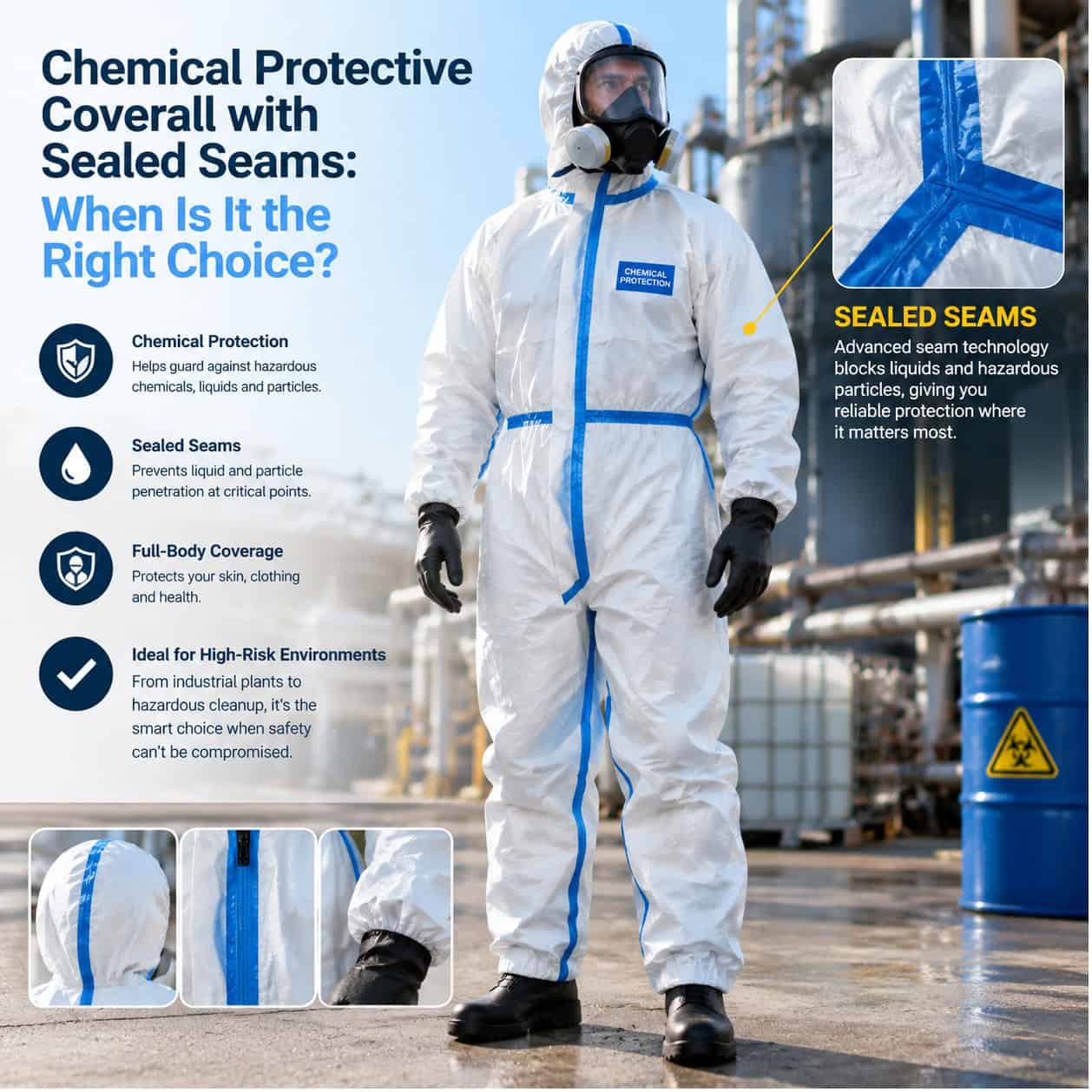 A stitched seam is a row of needle holes. That’s the whole problem, and it’s the reason you’re reading this instead of just grabbing the cheapest chemical protective coverall off the pallet.
Every standard disposable coverall has seams, and every seam is made by pushing a needle through fabric hundreds of times. Serged seams, bound seams, double-stitched seams, they’re all strong enough to hold a suit together. None of them are liquid-tight. Liquid chemical finds those puncture channels the way water finds a crack in a basement wall. It doesn’t need pressure, it doesn’t need a long soak. A splash on the shoulder during a pump transfer, a mist cloud settling on the sleeve while you spray, a fine powder working its way through a stitch line over twenty minutes of movement, that’s all it takes.
Sealed seams are the fix. Heat-sealed tape bonded over the seam, or ultrasonically welded fabric, closes the channel. The suit stops being a fabric shell with a hundred tiny leaks and starts behaving like a barrier.
So when is that worth paying for? Here’s the honest version, not the catalog version.
Sealed seams are the right call when the hazard can travel as a liquid, an aerosol, or a fine particle.
That covers more ground than most people expect. Type 3 and Type 4 suits, liquid-tight and spray-tight respectively, are almost always taped. Think chemical transfer and drum handling where a hose can pop. Think spray painting with isocyanates, where the mist is the exposure route and the lungs and skin are both in play. Think pesticide mixing and application, where concentrate splashes are the norm and the dose that matters is small. Think tank cleaning, confined space entry, spill response where you don’t yet know what’s in the puddle.
Fine particulates count too. Asbestos abatement, silica, lead dust, potent pharmaceutical compounds. Those particles are small enough to ride through a stitch hole, and they don’t need to be wet to do damage. If your exposure assessment says the airborne concentration is meaningful and the material is toxic by inhalation or ingestion, a sealed seam is cheap insurance.
Then there’s the case that gets argued about most: you don’t know what you’re walking into. Unknown spill, abandoned drum, a container that’s been sitting in a warehouse since before anyone currently employed got hired. When the hazard is unidentified, you default to the highest reasonable protection. Taped seams, taped zipper flap, taped glove and boot junctions. Nobody has ever been criticized for over-protecting on an unknown.
Now the part the sales reps skip.
Sealed seams do not upgrade the fabric. This is the single most expensive misunderstanding in the category. If the suit’s film or nonwoven isn’t rated for the chemical you’re facing, taping the seams just gives you a well-constructed suit that the chemical passes straight through. Permeation doesn’t care about your seam construction. Read the breakthrough data. ASTM F739, EN 652, whichever standard applies in your market. Find your chemical, find the breakthrough time, and if it’s under the duration of your task, walk away from that suit regardless of how good the seams look.
Sealed seams cost money. Typically two to three times the price of a comparable stitched suit. That’s real budget, and it’s the reason people try to talk themselves out of it. Sometimes they’re right to. If your exposure is dry, coarse, low-toxicity dust for fifteen minutes, a sealed seam is decoration. Spend the difference on gloves that actually fit and a half day of training. That’ll prevent more injuries.
Heat stress is the trade-off nobody puts on the spec sheet. Sealed suits are hotter. The tape doesn’t breathe, the film doesn’t breathe, and you’re sealed into a plastic envelope in a way a stitched suit is not. If the job is heavy, the environment is hot, and the chemical hazard is mild, an over-specified suit can create a bigger risk than it removes. People pass out in coveralls every summer. Match the protection to the hazard, not to your anxiety level.
Seam quality varies wildly, and you can spot it before you buy. Look at the tape width. Look at whether it’s continuous or spot-applied. Look at whether it’s wrinkled or lifting at the ends. Cheap taped seams peel after an hour of shoulder movement, and once the tape lifts you’re back to a stitched suit with extra steps. Squeeze the seam, flex it, see if the bond holds. A good supplier won’t mind.
The rest of the suit has to keep up. A taped seam on a suit with an unsealed zipper flap is a joke. Same for a loose hood-to-respirator interface, or a glove connection that lets liquid run down your forearm. Sealed construction only works as a system. Check every entry point, because contamination doesn’t read the marketing copy.
Fit deserves more attention than it gets. Too loose and you snag on every valve and ladder rung, which tears seams. Too tight and you stress the tape every time you reach overhead. Neither failure mode shows up in a spec sheet, both show up in incident reports.
And then there’s doffing. You can buy the best sealed suit on the market and defeat it in ninety seconds if you can’t get out of it without smearing the contaminated exterior across your neck. If your team hasn’t practiced removal, the seam construction bought you very little. This is a training problem, not a product problem, but it’s the one that decides whether the product works.
A simple decision rule, if you want one. Ask what form the chemical takes at the point of contact. Liquid, mist, spray, or fine dust, sealed seams. Coarse dry particulate with a low toxicity profile and short exposure, stitched is fine and your budget is better spent elsewhere. Unknown or mixed hazard, sealed, every time.
The coverall is one layer in a chain. Sealed seams are what stop that layer from being a formality.